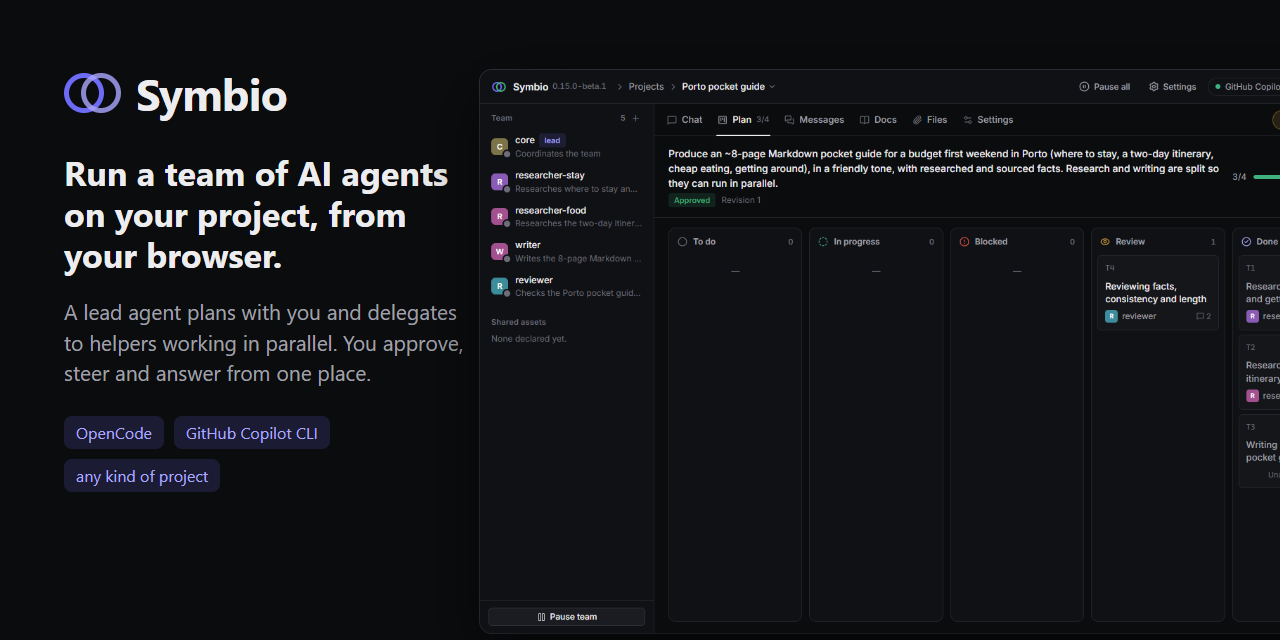
I have been running coding agents for a while, but the moment a project gets bigger than “fix this one file”, a single chat window starts to feel like a bottleneck. You end up copying context between terminals, telling one agent not to touch what another is touching, and manually stitching the results together. That is the problem symbio is trying to solve: it runs a team of AI agents on one project from a browser, with one lead agent coordinating the work and helper agents executing in isolation.
This is a practical walkthrough, not a product pitch. I will show how I set it up, what the lead and helper model looks like in a real session, and where I still keep my hands on the wheel. If you followed the chat harness and tool calling posts in the LLM series, symbio is a concrete example of those ideas applied to a multi-agent workflow: agents use tools, pass messages, and work through a loop that a human can inspect.
What symbio actually is
Symbio is a local Node.js web app with a React interface. You open it in your browser, point it at a folder, and talk to one lead agent called core. Core scopes the work with you, proposes a plan, and spawns helper agents when parallel or isolated work makes sense. Each helper can work in its own git worktree on a symbio/<name> branch, so two agents do not overwrite the same files by accident. When a helper finishes, core reviews the work and merges it back. The browser only talks to Symbio, and the agents run in a runtime you choose.
The important design choice is that Symbio is not tied to software projects only. A project is just a folder and a goal. The same machinery is used for research, documentation, and data cleanup: Symbio provides the coordination primitives – messaging, isolation, shared-asset ownership, approvals – and the agents decide how to organize the work. There are no fixed roles like “backend agent” or “writer”; core names helpers after what they do in this particular project.
Install and first run
The quick start is deliberately small. You need Node.js 22+ and, ideally, git for worktree isolation:
npm install -g symbio
sym
Symbio opens in the browser. On first run you install an agent runtime from the Projects page. Today that means OpenCode or GitHub Copilot CLI (preview). Symbio does not ship a runtime; it installs the one you pick into ~/.symbio/runtimes/<kind> and records where it starts. That detail matters because the runtime is the thing actually running the model sessions – Symbio is the coordinator around it, with one interface for both runtimes.
After that, click New project, choose a folder, and describe the goal. For an existing repo, core inspects the folder, reads guidance files like README and AGENTS.md, and builds an understanding before proposing changes. Symbio can initialize git for you when the folder is not a repository yet. For an empty folder, core starts from scratch. My advice is to try a throwaway folder first: a real multi-agent session burns tokens quickly, and the cost per agent is shown in the UI.
The plan before the work
The part I like most is that core does not immediately spray tasks at helpers. It proposes a plan first. The plan has a goal, tasks with dependencies, and “done when” checks that can be verified by someone who did not do the work. You approve or ask for changes in the Plan tab. Nothing gets assigned before approval, and core discusses the scope with you before it even submits the plan.
A minimal mental model looks like this:
Project: write a pocket travel guide

core
  |- proposes plan
  |- declares shared assets (notes/, glossary.md)
  `- after approval:
       |- helper: researcher  (own worktree, task T1)
       `- helper: writer      (waits for T1, then drafts chapters)

Human
  `- approves plan, answers questions, reviews finished tasks
The shared-asset piece is where Symbio earns its keep. If two helpers might edit the same file, folder, database, or external system, core declares it as a shared asset. A helper calls request_asset before touching it and only proceeds when granted. At merge time, changes to path-pattern assets that were not granted get flagged instead of silently merged. That is a simple rule, but it prevents a lot of multi-agent chaos, and it is the part I would want in any system that lets several agents edit one folder.
What a helper session looks like
Every agent is a session in the selected runtime. Core gets the coordinator brief and works in the project root. A helper gets a worker brief, a task, and a working directory – usually a git worktree. Helpers report progress with update_task, talk through Symbio’s message bus with send_message, and can ask the human for decisions through ask_human. Messages delivered mid-turn are handed to the agent on its next Symbio tool call, so it does not have to finish its current turn to see them.
The tool surface is intentionally small and explicit. From the agent protocol, the common tools include:
send_message(to, kind, text)
ask_human(question, context, options)
request_asset(asset, reason)
release_asset(asset, summary)
update_task(task_id, status, summary, guide?)
list_tasks() / list_team() / list_assets()
I like this because it makes coordination observable. Messages are logged to .symbio/messages.jsonl, plans live in .symbio/plan.json, and asset ownership is tracked in .symbio/assets.json. When something goes wrong, I can inspect plain files instead of guessing what the model “thought” happened. The UI draws its status and kanban board from these records and live runtime events, not from asking a model to summarize itself.
Where it helps, and where I still supervise
Symbio is good at the boring coordination work: splitting tasks, keeping helpers isolated, surfacing approvals, and preserving a record of who did what. It is also useful when a task can run in parallel – one helper researches while another drafts, or one checks a codebase while another writes docs. The project can move from OpenCode to Copilot CLI without converting the team’s state, because the plan, messages, assets, and git history belong to Symbio or git, not to the runtime conversation. As a rough signal that this is maintained code rather than a demo, the repo runs CI on every pull request, including end-to-end tests against both runtimes.
Where I still supervise: task boundaries, review quality, and anything with side effects. A shared database, a deploy, a production config, or a messy merge still needs a human looking at the diff. Symbio makes that easier by putting approvals in “Needs you” and by checking merges against granted assets, but it does not turn agents into unattended autopilot. The right mental model is a small team with a lead you can audit, not a magic button. On a small machine I also keep the workload to one heavy job at a time; the runtime runs processes at low priority, but there is no hard CPU cap.
If you want to go deeper, the symbio repository has the architecture notes, agent protocol, and runtime docs, and the package is on npm. The next post covers the part I glossed over here: how the plan actually flows from core to helpers, and why that handoff is the difference between parallel work and parallel confusion.
Leave a Reply