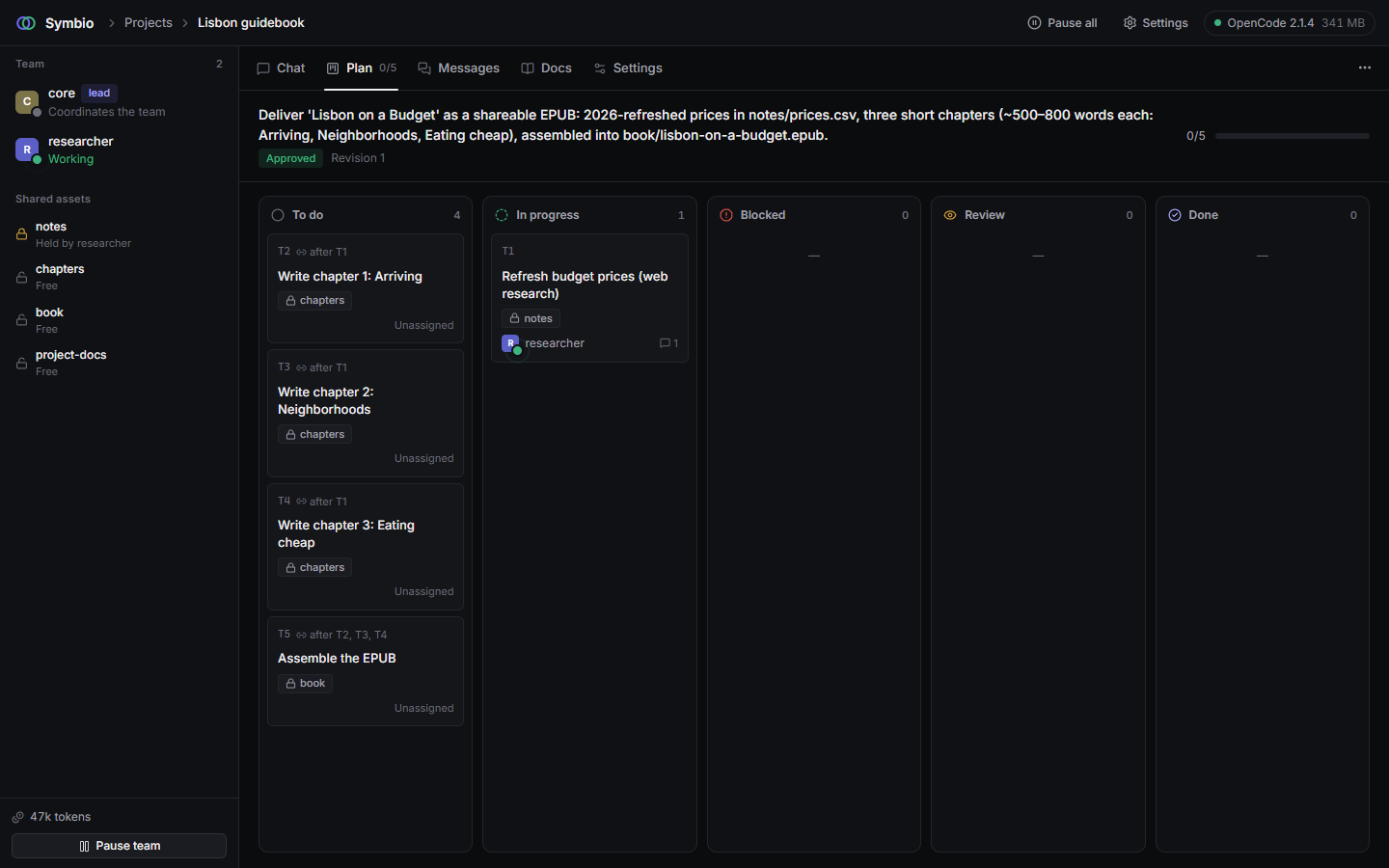
Ask four agents to “improve the project” and you will get four conflicting sets of edits. The interesting problem in multi-agent work is not making agents run; it is making their work compose. In symbio, that composition happens through a plan. One lead agent – core – owns the plan, and helpers receive precise pieces of it. This post explains how that handoff works in practice, from task dependencies to reviews, using the lead agent / helpers model as implemented in the tool surface.
This follows on from the tool calling and chat harness posts in the LLM series. Those covered a single model calling tools and keeping conversation state. A plan is the next layer: a shared, inspectable object that several agents can act on without all reading the same chat history.
Two roles, not a hierarchy of job titles
Symbio deliberately avoids roles like “frontend agent” or “QA agent”. There are only two kinds of agent. Core is the coordinator: it works with you to scope the project, proposes the plan, declares shared assets, spawns helpers, reviews their reports, and merges or marks tasks done. Helpers are workers created for a specific piece of work, named for what they do in this project – names like researcher or reviewer, not permanent titles.
Core coordinates rather than doing the work. Even a follow-up request from you normally becomes a task for a helper, so core stays responsive. Core reads files and reviews diffs, writes project docs, and performs merges, but the implementation work goes to helpers. That separation sounds bureaucratic for a two-task project, and it is: Symbio’s default is one helper, and each extra one has to be justified by independent work. Idle helpers cost nothing and keep their context, so they are reused rather than recreated.
Submitting a plan
A plan is a goal plus tasks. Each task has a title, a description, dependencies, and a done_when statement: how someone who did not write the code can check that the work is finished. Core sends this with the submit_plan tool. The Plan tab shows it to you for approval, and nothing is assigned before you approve. In Plan mode, Symbio enforces this even more strictly – core’s tools refuse to create helpers, assign tasks, merge, or make changes, and its edit permissions are denied.
A small plan I ran looks roughly like this in structured form:
{
  "goal": "Write a pocket guide to Porto",
  "tasks": [
    {
      "id": "T1",
      "title": "Research neighbourhoods and costs",
      "done_when": "notes/ has a sourced list of 8 places with prices",
      "dependencies": []
    },
    {
      "id": "T2",
      "title": "Draft the chapters",
      "done_when": "chapters/ has 4 drafts consistent with notes/",
      "dependencies": ["T1"],
      "review": true
    }
  ]
}
The dependency is the important field. assign_task refuses to hand a task to a helper while its dependencies are unfinished, which is how the writer in my example cannot start before the researcher finishes. Small follow-ups can be added later with add_task without a fresh approval round. You can also edit done_when on the board; when that happens, the helper currently on the task is told, so the finish line does not move silently under it.
Spawning helpers and giving briefs
Core creates a helper with spawn_agent: a name, a purpose, and usually a first task. Each helper is its own runtime session with its own model and working folder. The sessions run in a runtime such as OpenCode or GitHub Copilot CLI – Symbio talks to both through one interface. In a git project, an “own” helper works in a worktree on branch symbio/<name> and core merges its commits; a “shared” helper works directly in the project folder, so its files appear immediately and there is nothing to merge. Without git, helpers always share the folder. Core can also pin a helper to a model, choose its reasoning effort, and give it skills.
The brief is what makes delegation work. A helper is told the project’s conventions, the task, its done_when, and the rules it must respect – for example, no AI attribution lines in commits, ask before installing software, never read secrets. Those rules come from the project’s AGENTS.md and Symbio’s own safety rules. A good brief is specific enough that the helper does not need to interrupt you, but leaves room for judgment inside its task.
Messages, questions, and shared assets
Once work starts, communication goes through Symbio’s message bus. Messages have kinds: info for an FYI, request when something is needed, blocking when the sender cannot continue, and urgent for an interruption. Everything is logged to .symbio/messages.jsonl. If you have ever lost a decision in a long chat, having a single log you can grep is a relief. A loop guard caps conversational messages between the same two agents (20 per 30 minutes by default); protocol traffic like task assignments and asset grants does not count.
Questions for you are not chat messages. ask_human adds one to the “Needs you” list, numbered Q1, Q2 and so on, with context and suggested answers. Asking the same thing twice is refused. You answer when you have a moment and the agent carries on. That is a small change with a big effect: it keeps the chat usable as a status stream while decisions collect in one place.
Shared assets are the other half of the model. Anything more than one agent could change – a folder like notes/, a config file, a database, a spreadsheet – can be declared by core. A helper calls request_asset(asset, reason), is granted immediately if nobody holds it, and must not touch it before the grant. When it is done, release_asset hands it back with a summary. At merge time, edits to a path-pattern asset the helper was not granted are flagged rather than merged. This is the mechanism that turns “several agents in one folder” from a race condition into a queue.
Reports, reviews, and done
A helper reports with update_task: in-progress, blocked with a reason, or review with a summary and a review guide – where to look, which steps to run, and what should be seen. The guide matters because core, or you, should be able to check the work without redoing it. If a helper ends its turn without reporting, Symbio reminds it once, then tells core it has gone quiet.
What happens next depends on the project’s review setting. With the default, core reviews and calls merge_work, which marks the task done. With “every”, a finished task waits in your To review list until you approve it; with “marked”, only tasks flagged when the plan was proposed wait for you. Send back reopens the task and gives your note to the helper. A review gate is worth enabling when the output is going public – I use it for blog drafts and leave it off for mechanical refactors.
Why this beats one long conversation
The plan gives every agent the same source of truth without copying the whole chat into each prompt. A helper sees its task and its dependencies; core sees the whole board; you see the approvals and questions. When a session gets too long or a runtime crashes, Symbio can start a fresh session with a handoff note built from the plan, asset register, and message log, so the work continues from recorded facts instead of a fading conversation. That is the practical payoff of the lead agent / helpers model: not more agents, but less shared confusion. The symbio repo documents the protocol in full if you want to see the tool signatures behind these examples.
Leave a Reply